Vue in 2026 - What's New and What's Still Missing
A practical look at Vue as of August 2026 - what's stable in Vue 3.5, what's in Vue 3.6 RC with Vapor Mode and Alien Signals, and where the ecosystem still has gaps.
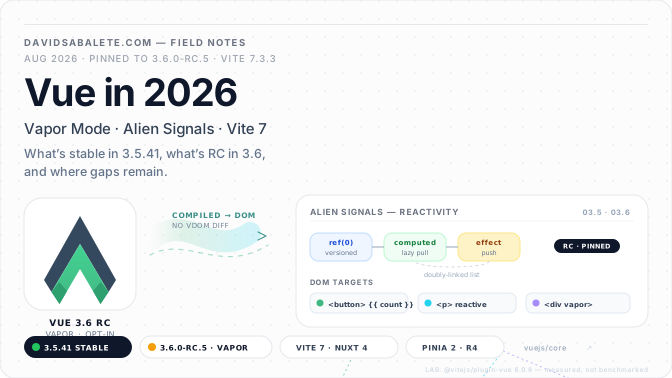
Vue.js remains a favorite for its simplicity, flexibility, and progressive adoption. As of August 2026 the stable release is Vue 3.5.41 and the next release Vue 3.6 is in RC (3.6.0-rc.5 as of Aug 21). This post covers what is actually shipping, what is in RC behind an opt-in flag, and where gaps remain. Versions and behavior are pinned to the RC date - check vuejs/core releases before adopting.
What's New in Vue in 2026
1. Vue 3.6 RC: Vapor Mode and Alien Signals
There is no Vue 4.0. The major work for 2026 is Vapor Mode - an opt-in compilation strategy in Vue 3.6 that bypasses the Virtual DOM for supported components - and a rewrite of @vue/reactivity on Alien Signals.
- Vapor Mode is opt-in per component, not global. Add
vaporto the SFC block:App.vue<script setup vapor lang="ts"> import { ref } from 'vue' const count = ref(0) function increment() { count.value++ } </script> <template> <main> <h1>Vapor counter</h1> <button @click="increment">Increment</button> <p aria-live="polite">Count: {{ count }}</p> </main> </template>
For a fully Vapor app:createVaporApp(App).mount('#app'). Mixed apps usevaporInteropPlugin, but that brings the VDOM runtime back. JSX/render functions still use VDOM. - Limits as of RC.3/RC.5:
vaporInteropPlugindocs and RC changelogs list unsupported APIs: Options API,app.config.globalProperties,getCurrentInstance()returnsnullin Vapor components,v-memo, per-element@vue:xxxevents, and$el/$props/$attrs/$slots/$refson Vapor components. Custom directives use a new interface with a reactive getter and cleanup - review before porting. - Alien Signals reactivity: The change often confused with Vapor. The reactivity refactor landed in Vue 3.5 (version counting + doubly linked lists) and continues in 3.6 with the Alien Signals implementation. It improves computed and effect performance and reduces memory for reactive graphs. It is separate from Vapor's VDOM elimination. Measure on your app - there is no universal 20-30% guarantee.
- Event handling change (RC.2+): Listeners attach directly to elements by default. Document delegation is opt-in via
.delegatefor supported static events.compilerOptions.eventDelegationwas removed.
Rule of thumb: keep the standard compiler for stability and breadth. Try Vapor on isolated, measured hot paths when you can pin
vue@3.6.0-rc.x+@vitejs/plugin-vue 6.0.8+Vite 7.xand accept RC churn.
2. Vue Macros: Useful, but Community - Not Core
Vue Macros remain a community project maintained by sxzz, not a first-class core feature. They provide compile-time helpers that complement <script setup>.
defineOptions: FornameorinheritAttrsonly. Noprops/emitsinside it.MyComponent.vue<script setup lang="ts"> defineOptions({ name: 'MyComponent' }) </script>definePropsanddefineEmits: Compiler macros, no import needed. Use in<script setup>:MyComponent.vue<script setup lang="ts"> const props = defineProps<{ title: string count?: number }>() const emit = defineEmits<{ (e: 'update', value: number): void }>() </script>defineSlots: Also a macro, no import:MyComponent.vue<script setup lang="ts"> const slots = defineSlots<{ default(props: { item: string }): any header(): any }>() </script>
Note: Reactivity Transform ($ref) was dropped in 2023 and is not recommended. Do not use import { $ref } from 'vue/macros'. Use ref() / computed() explicitly.
3. VueUse: The Composition Utilities Library
VueUse continues to expand past 200 utilities. Highlights unchanged in 2026:
- State persistence:
useLocalStorage,useSessionStorage,useStorage - Browser APIs:
useGeolocation,useClipboard,useIntersectionObserver,useResizeObserver - Animation:
useTransition,useSpring(viauseElementBoundingpatterns) - Performance:
useThrottleFn,useDebounceFn,useMemoize
import { useLocalStorage } from '@vueuse/core'

const darkMode = useLocalStorage('darkMode', false)
4. Vue Router: Still 4.x, Typed Routes via Tooling
There is no Vue Router 5.0. The stable line is Vue Router 4.x. Type-safe routes come from tooling, not a defineRoute core helper:
unplugin-vue-routeror Nuxt file-based routing generate typed params/query/meta.- In-code guards remain
beforeEnter,onBeforeRouteLeave,onBeforeRouteUpdate. There is noonBeforeRouteEntercomposition guard as a macro.router/index.tsimport { createRouter, createWebHistory } from 'vue-router' const router = createRouter({ history: createWebHistory(), routes: [ { path: '/user/:id', component: () => import('./User.vue'), props: true, meta: { requiresAuth: true } } ] }) router.beforeEach(async (to) => { if (to.meta.requiresAuth) { const user = await fetchUser(to.params.id as string) if (!user) return '/404' } })
For full type safety, prefer file-based routing with auto-generated types rather than hand-rolled defineRoute.
5. Pinia: Still 2.x, the Standard Store
Pinia remains 2.x and the recommended store for Vue. There is no shipped Pinia 3.0 with auto-subscriptions.
- Use
defineStorewith Setup syntax for full TypeScript inference. - For persistence, compose with VueUse:stores/user.ts
import { defineStore } from 'pinia' import { ref } from 'vue' import { useLocalStorage } from '@vueuse/core' export const useUserStore = defineStore('user', () => { const user = ref<{ id: string; name: string } | null>(null) const darkMode = useLocalStorage('darkMode', false) return { user, darkMode } }) - Actions are typed via inference - no special
Type-Safe Actionsgenerics needed beyond normal TS. DevTools integration continues viadevtools-kit.
6. Vite 7: The Current Build Tool
Vite 6 shipped Nov 2024, Vite 7 shipped mid-2025 and is current with Vue in Aug 2026. Changes relevant to Vue:
- Near-instant HMR even in large projects, ESM-only plugin model
- CSS nesting and
@unhead/vuepatterns are common, butCSS @applyis Tailwind-specific, not Vite core .envhandling and type generation improved; seevite.dev(notvitejs.dev)
npm create vue@latest my-app
cd my-app
npm install
npm run dev
Pin versions in labs: vue@3.6.0-rc.5, @vitejs/plugin-vue@6.0.8, vite@7.3.3 as used for this post's Vapor verification.
7. Vue DevTools: Iterative, Not Overhauled
DevTools continue to improve via @vue/devtools-kit / vite-plugin-vue-devtools, with component-tree inspection, timeline, and perf hints. Features like time-travel debugging exist for Pinia state, but there is no shipped "complete overhaul with built-in profiler vNext" - measure with Chrome Performance panel and app.config.performance = true.
8. Server-Side Rendering: Nuxt 4 is the Path
Vue core SSR is low-level. For streaming, partial hydration, and head management, Nuxt 4 is the recommended layer in 2026:
- Streaming SSR and island components (
<NuxtIsland>,serverOnly) for partial hydration - SEO head via
@unhead/vue/useHead()/useSeoMeta()(not manual meta tags) - Lazy hydration controlled at the component/route level
Low-level core example (rarely used directly when on Nuxt):
import { createSSRApp } from 'vue'
import { renderToString } from 'vue/server-renderer'

const app = createSSRApp({ /* ... */ })
const html = await renderToString(app)
9. Web Components: Stable but Niche
defineCustomElement is stable for building custom elements with Vue, but slot fallback and prop handling follow Web Components specs, not Vue template sugar.
import { defineCustomElement } from 'vue'

const MyElement = defineCustomElement({
  props: { message: String },
  template: `<p>{{ message }}</p>`
})

customElements.define('my-element', MyElement)
Use when you ship a design system to non-Vue consumers; otherwise prefer regular SFCs.
10. Internationalization and Accessibility
- Vue I18n 10+ is incremental: message syntax, pluralization, and datetime/number formatting. It does not ship built-in
a11yhelpers. - For a11y, use VueUse (
useFocusTrap,useActiveElement) plus manual ARIA/focus management. Rely on component libraries orradix-vue/reka-uifor headless primitives rather than expecting core helpers.
import { createI18n } from 'vue-i18n'

const i18n = createI18n({
  legacy: false,
  locale: 'en',
  messages: {
    en: { hello: 'Hello, {name}!' },
    es: { hello: '¡Hola, {name}!' }
  }
})
What's Still Missing in Vue in 2026
1. Resumability
Vue hydrates on the client after SSR. Qwik/Astro-style resumability (serialize and resume without re-executing) is not a core Vue feature. Workarounds are service workers + useState/useAsyncData in Nuxt, but not zero-JS resume.
2. Fine-Grained Reactivity for Huge Collections
Reactivity tracks at property granularity. For 10k+ row tables, updates can still be costly. Current tools are shallowRef / shallowReactive / markRaw / v-memo plus virtualization (vue-virtual-scroller). There is no shipped "lazy reactivity mode" that auto-skips untracked props.
import { shallowRef } from 'vue'

const rows = shallowRef(largeArray) // replaces whole array on change, avoids deep proxy
3. Native Mobile
No official Vue Native. The path is Ionic Vue, Capacitor, or NativeScript-Vue via Vite. Compared to React Native/Flutter, integration is community-driven and lacks a single official runtime.
4. Error Boundaries
No <ErrorBoundary> component in core. The primitive is onErrorCaptured plus app.config.errorHandler. Libraries and Nuxt's NuxtErrorBoundary fill the gap:
<script setup lang="ts">
import { onErrorCaptured, ref } from 'vue'

const error = ref<unknown>(null)
onErrorCaptured((err) => {
  error.value = err
  return false // stop propagation
})
</script>

<template>
  <div v-if="error">Something went wrong.</div>
  <slot v-else />
</template>
5. Web Workers
No core useWorker. Use Comlink, workerize, or Vite's ?worker import. A common pattern:
import MyWorker from './worker?worker'
const worker = new MyWorker()
worker.postMessage(payload)
A first-class useWorker composable is still a community wishlist item.
6. Opinionated Best Practices
Vue is intentionally flexible. The official stance is documented in the style guide and create-vue prompts (Router, Pinia, Vitest, ESLint, TypeScript). Inconsistency across teams remains a people problem, not a missing core feature.
7. Serverless Integration
No Vue Serverless Kit. The integration layer is Nuxt server routes (server/api/*.ts), Nitro presets for Netlify/Vercel/Cloudflare, and SDKs for Supabase/Firebase. Vue core stays render-layer agnostic.
8. Advanced Docs
Official docs are strong for 80% of use cases. Advanced reactivity (effectScope, customRef), custom directives with TS, and perf tuning for large apps still require RFCs, source reading, and community posts. A dedicated advanced section would help.
The Near-Term Roadmap
As of Aug 2026:
- Vue 3.6 stable with Vapor Mode stable for the supported subset and Alien Signals as the default reactivity engine. Check the RC changelog for the exact supported subset before migrating.
- Vapor stabilization, not Vue 4 or Vue 5. Vapor remains opt-in and interops with VDOM via
vaporInteropPlugin. - Tooling alignment:
@vitejs/plugin-vuefeatures.vaporfor global opt-in, Rolldown-based builds in Vite 7, and continued@vue/devtools-kitwork. - Edge and WASM remain experimental community explorations, not roadmap commitments.
Should You Use Vue in 2026?
Yes, for the same reasons as before: approachability, single-file components, and a mature ecosystem with Nuxt 4 + Vue Router 4 + Pinia 2 + Vite 7.
Choose Vue when you value progressive adoption and SFC ergonomics.
Consider alternatives only for specific constraints:
- Native mobile first: React Native or Flutter
- Zero-JS resumability as hard requirement: Qwik or Astro islands
- Signals-only fine-grained with no VDOM at all: Solid or Svelte 5
For most SPAs and SSR apps, Vue 3.5 stable is the safe default. Evaluate Vapor in a pinned lab on measured bottlenecks.
Conclusion
As of August 2026, Vue is stable at 3.5.41 and entering 3.6 RC with Vapor Mode as an opt-in compiler and Alien Signals improving reactivity. With Pinia, Vue Router, VueUse, and Vite 7, it remains a strong choice for modern web apps. Gaps around resumability, native mobile, and worker ergonomics persist, but Nuxt and the wider ecosystem cover most production needs.
Verify the Vue release channel (latest vs rc) and Vapor's supported subset before you adopt RC features.
Join the Discussion
Have you tried Vapor Mode on a real component? What limits did you hit? Open an issue or reach me via the contact links.
Additional Resources
- Vue Releases - check
latestvsrctags - Vue Docs
- Vue 3.6 RC changelog
- Vue Macros
- VueUse
- Pinia
- Vite - current site
- Vue Router
- Vue DevTools
- Nuxt